
PVsyst 7.4.8 is a widely used software tool for the design, simulation, analysis, and feasibility assessment of photovoltaic (PV) systems — both grid-connected and off-grid/stand-alone (including pumping, DC-grid, hybrid or storage-integrated systems).
PVsyst 7.4.8 Description
Originally developed at the University of Geneva, it is accepted worldwide as a standard engineering tool for PV project modeling and solar system analysis. PVsyst Free Download is used by engineers, researchers, designers, consultants, and also by educators and students whenever a thorough and realistic simulation is needed before installation.
PVsyst 7.4.8 is designed for use by architects, engineers, and researchers and is a very useful educational tool. PVsyst Free Download has a detailed text-based help menu that explains the methods and models used and provides a user-friendly, guided approach to developing a project. PVsyst is able to import meteorological data from various sources and personal information.
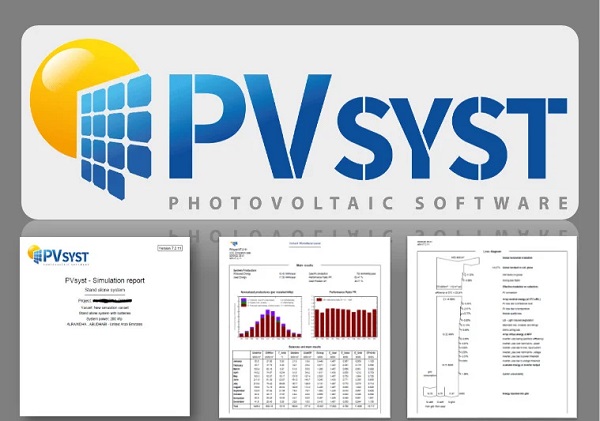
Features For PVsyst 7.4.8

-
PVsyst allows configuring a complete PV system: selecting modules, inverters (or other power electronics), setting array layouts, defining system type (grid-connected, off-grid, pumping, DC-grid, hybrid, storage, etc.).
-
It helps size the system (array size, inverter sizing, etc.) based on technical requirements or constraints (available area, needed power, load profile, etc.).
• Detailed Energy Yield Simulation & Performance Analysis
-
Performs hourly (or high-resolution) simulations for the full year to estimate energy production, taking into account weather, solar irradiation, system losses, orientation/tilt, shading, etc.
-
Calculates key metrics: total energy yield, specific yield (kWh/kWp), performance ratio, losses breakdown (shading, mismatch, temperature, wiring, conversion, etc.).
-
Can handle advanced setups: mixed orientations, trackers + fixed arrays, hybrid systems, storage/battery integration, off-grid or grid-tied, and more.
• Shading & 3D Layout / Terrain Modeling
-
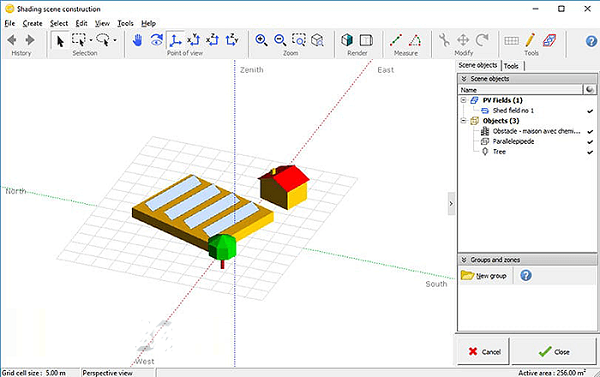
Offers a 3D “Near-Shading” tool: you can build a 3D scene of the PV installation environment — including buildings, obstacles, terrain — to study shading over time and its impact on production.
-
Useful for complex sites (terrain, hills, bifacial panels, variable orientation) and to optimize layout to minimize shading or mismatch losses.
• Wide Component & Meteo / Irradiance Database & Data Input Flexibility
-
Includes large databases of PV modules, inverters (and other components), which help model real-world systems with actual components.
-
Let users import meteorological / weather/irradiance data from external sources (e.g., standard climate data sets), or use built-in data for many locations, which enables global coverage and realistic simulations tied to the local climate.
-
Can import custom weather or measured data — useful for matching simulations with real monitoring data or for site-specific studies.
• Financial & Feasibility / Risk / Economic Analysis Tools
-
Apart from energy yield and technical simulation, PVsyst supports economic evaluation: e.g., cost estimation, Levelized Cost of Energy (LCOE), payback, profitability, yield vs cost, comparisons across scenarios.
-
Useful for feasibility studies for small-scale installations (residential, rooftop), mid-size commercial, or utility-scale solar projects.
System requirements:
- All Windows client versions currently supported by Microsoft: Windows 8, Windows 10 (32-bit or 64-bit)
Up-to-date Windows 7 systems - Other OS like MAC OS X (see here) and LINUX are supported through the use of a virtual machine running Windows (VirtualBox successfully tested).
- OS not supported:
- Windows servers, Application servers (Citrix, ZenDesktop, ZenApp,…).
Password: 123